News & Projects in Development
News & Announcements
Updates, milestones, and projects in development across Miryalan Dynasty and its divisions.
Results for "M-I Drone: Advancing Intelligent Aerial Technology" (clear)
21 Sep 2026
M-I Drone: Advancing Intelligent Aerial Technology
MeghVahan | M-I | Intelligent Unmanned Aerial Systems The future of aerial technology is moving toward intelligent, adaptable, and purpose-driven unmanned aircraft. MeghVahan’s M-I drone represents a modern approach to quadcopter design, combining a co
A New Approach to Drone Design
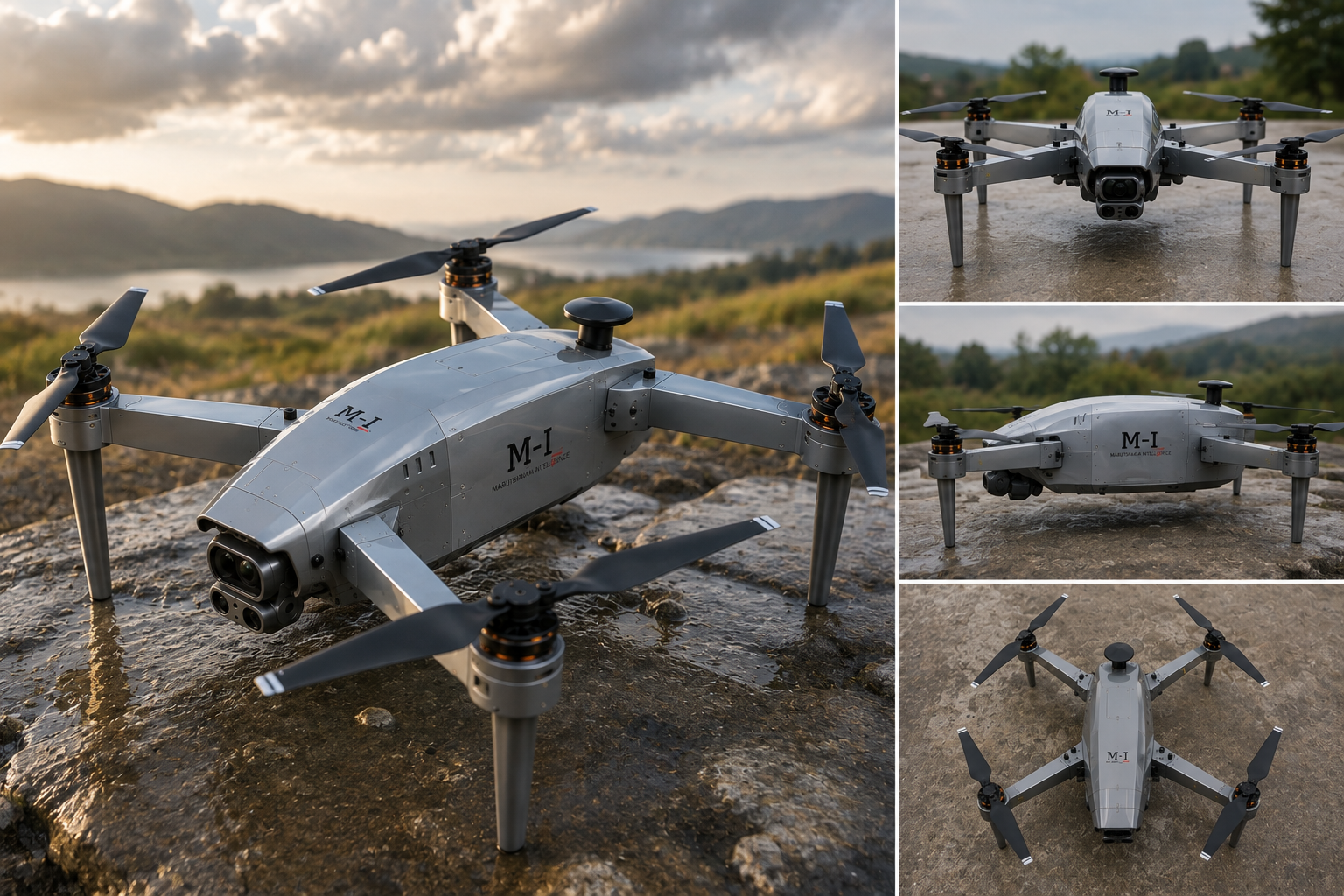
The M-I features a four-arm quadcopter configuration, a streamlined central body, and a front-mounted camera system. Its modern industrial design reflects the growing demand for drones that can operate in diverse environments while supporting specialized aerial tasks.
The aircraft’s modular appearance provides a foundation for exploring different payloads, sensing technologies, navigation systems, and mission-specific configurations.
From aerial inspection to environmental observation, intelligent drone platforms are becoming an important part of modern engineering.
Intelligent Aerial Systems for Multiple Applications
The M-I drone concept can support the development of aerial solutions for a range of industries.
1. Aerial Inspection
Drones can help inspect infrastructure, industrial facilities, construction sites, and difficult-to-access locations. Camera-based observation can reduce the need for people to enter certain hazardous or elevated areas.
2. Environmental Monitoring
Unmanned aerial systems can be used to observe landscapes, vegetation, water bodies, and environmental conditions. With suitable sensors, future configurations may support data collection for environmental research.
3. Industrial Operations
Drone technology can support industrial surveying, site observation, and operational monitoring. Intelligent flight systems can improve the efficiency of selected aerial tasks.
4. Research and Innovation
The M-I platform provides an opportunity to explore flight control, embedded electronics, aerial imaging, navigation, and autonomous systems as part of ongoing engineering research.
Engineering Behind the M-I
A modern quadcopter combines several engineering disciplines in one aircraft.
Airframe Design: The central body and arms must support the aircraft’s structure, motors, electronics, and payload.
Propulsion: Four motor-and-propeller assemblies generate the thrust required for vertical flight, hovering, and maneuvering.
Flight Control: Flight controllers coordinate motor speeds to maintain stability and respond to pilot commands.
Navigation: Positioning and navigation technologies can support flight planning and operational awareness.
Imaging and Sensors: Camera systems and optional sensors can collect information for aerial observation and specialized missions.
Embedded Systems: Electronics and software integrate the aircraft’s control, communication, and sensing functions.
These systems work together to create a platform that can be adapted to different aerial technology requirements.
Built for the Future of Unmanned Aviation
The development of intelligent drones is creating opportunities in aerospace engineering, robotics, electronics, software, and industrial automation.
MeghVahan’s M-I reflects this direction through a design focused on modern aerial mobility and technological exploration. Future development may include mission-specific configurations, advanced sensing, improved flight control, and greater levels of automation, subject to engineering validation and testing.
MeghVahan – Engineering Beyond Conventional Mobility
MeghVahan explores engineering solutions across Automotive, Civil, Defence, Marine, Space, and Tourism applications.
The M-I drone is part of this broader vision of developing innovative mobility and aerospace technologies. Through research, design, prototyping, and testing, MeghVahan aims to explore new possibilities in unmanned aerial systems.
Conclusion
The M-I drone represents the possibilities of modern quadcopter engineering. With its compact airframe, four-rotor configuration, and camera-equipped design, it provides a foundation for exploring intelligent aerial systems and their applications.
As unmanned aviation continues to develop, platforms such as the M-I demonstrate how aerospace engineering, electronics, software, and intelligent systems can come together to shape the future of aerial technology.
MeghVahan – Exploring the Future of Flight.
Explore more: https://miryalan.com/meghvahan